Abstract. This technical note presents the architecture of a hybrid AI product-generation system for PicsForDesign (PFD). The system combines externally supplied foundation models, PFD-owned orchestration, retrieval over licensed creative archives, compact style and character adapters, deterministic production tooling, multimodal evaluation and human accountability. Its primary engineering constraint is not unconstrained image synthesis; it is the reliable production of commercially usable, sufficiently novel and rights-governed digital products with a bounded generation budget. We describe the modules, data contracts, routing policy, novelty gates, quality controls, model lifecycle and an agent-native operating model designed to automate routine company execution without pretending that software can replace legal responsibility.
1. Research objective and operating thesis
PFD is developing an agent-native creative company: a company in which routine planning, production, validation, packaging, publication preparation, monitoring and reporting can be executed by software agents, automation workers and trained model adapters. The long-term objective is a zero-traditional-employee operating model for repeatable operational work. This is an organizational design target, not a claim that machines are legal persons or that responsibility disappears. Owners and designated reviewers remain accountable for rights, finance, safety, exceptional decisions and deployment approval.
The technical question is therefore broader than “Which model can draw an image?” It is: How can a small, auditable system repeatedly transform governed business context into unique digital products, reject unsafe or repetitive outputs, minimize paid inference, learn from outcomes and preserve a verifiable chain of decisions?
Research questions
- How can category, store and author style be represented without copying individual archive works?
- How can a planner produce three genuinely different products per day instead of small prompt variations?
- When should the system use prompting, retrieval, reference conditioning or a LoRA adapter?
- How can textual and visual novelty be measured before a product reaches publication?
- How can image-generation cost be bounded to one strong attempt and at most one repair?
- Which decisions may be automated, and which must remain under accountable human governance?
2. System boundary: what PFD owns
The PFD system is intentionally hybrid. Foundation-model training is capital intensive and is not the first differentiator for this product. PFD uses qualified external text, vision and image-generation models where they are economically appropriate. The proprietary layer is the control system around those models: data governance, Style DNA, concept planning, retrieval, prompt compilation, routing, novelty measurement, visual QA, cost policy, packaging, model registry and feedback memory.
| Layer | Primary responsibility | Ownership model |
|---|---|---|
| Foundation models | General language, vision and image generation | External APIs or licensed/open model weights |
| PFD orchestration | State machine, policies, retries, idempotency and audit trail | PFD-owned application logic |
| Creative memory | Rights-approved archive summaries, embeddings, exclusions and outcomes | PFD-governed data layer |
| Adapters | Store, category, style-family or recurring-character adaptation | Versioned PFD LoRA artefacts trained only on eligible data |
| Evaluation | Quality, novelty, safety, rights and production-readiness gates | PFD-owned policies and benchmarks |
| Production | Local crops, previews, watermarks, manifests and packages | Deterministic PFD tooling |
This separation is important. A model provider may improve or deprecate a model; PFD should be able to change that provider without losing its creative memory, acceptance criteria or production history. The durable product is therefore the workflow plus governed data plus evaluation, not a hard-coded dependency on one API.
3. Hybrid architecture
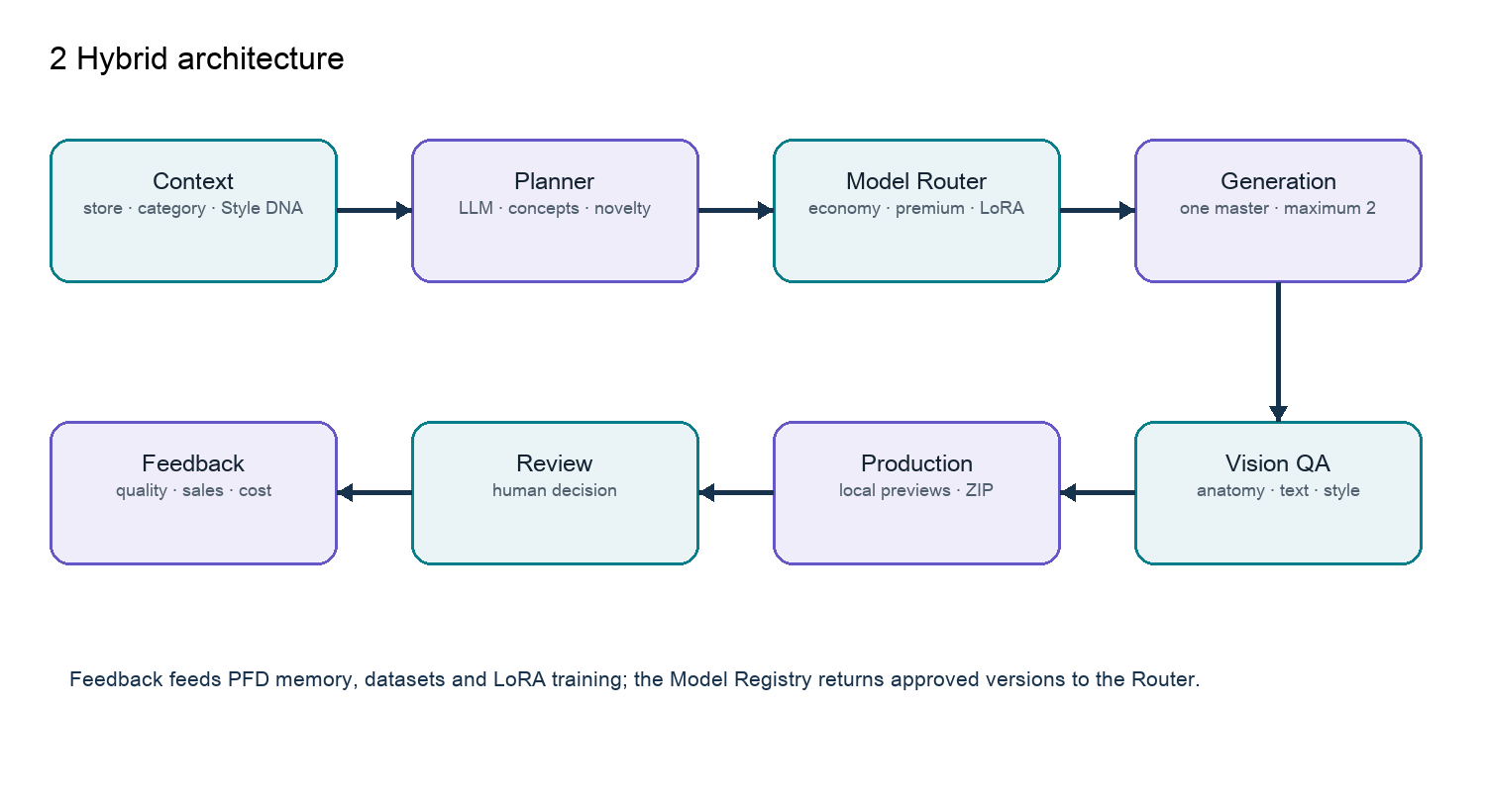
Governed Context
Loads store, category, licence, audience, format, price and campaign constraints. No generation begins before rights and policy checks establish what data may be used.
Style DNA
Represents palette, line character, composition, detail density, rendering traits, prohibited motifs and similarity exclusions as structured attributes rather than a single vague style prompt.
Concept Planner
Produces semantically different concepts, titles, descriptions and shot plans. It works against recent-history memory so that novelty is designed before pixels are generated.
Retrieval Layer
Retrieves eligible references, prior failures, successful prompt fragments and category constraints. Retrieval supplies evidence; it does not authorize copying.
Prompt Compiler
Converts the product contract into model-specific positive, negative and repair prompts while preserving composition, anatomy, transparency and export requirements.
Model Router
Selects an economy, premium, editing or LoRA-enabled route using predicted quality, cost, latency, privacy and licence constraints.
Generation Worker
Creates one master asset under an explicit paid-attempt budget. The current design permits a maximum of two paid attempts: first pass plus one targeted repair.
Vision QA
Evaluates anatomy, text artefacts, crop safety, subject completeness, background separation, consistency with the brief and visible production defects.
Novelty Gate
Compares title and image embeddings, perceptual hashes and structured attributes against recent products and protected reference sets.
Production Builder
Derives gallery crops, thumbnails, contact sheets, watermarks and ZIP packages locally. These transformations do not consume a second image-generation call.
Review Console
Presents the master, evidence, warnings, cost, dataset provenance and manifest to the accountable reviewer for approve, reject or targeted-repair decisions.
Feedback & Registry
Records review outcomes, defects, cost and downstream performance. Approved LoRA and routing profiles are versioned, evaluated, promoted by canary and reversible.
4. A product is a contract, not merely an image
Every run begins with a typed product contract. The contract is the interface between business intent and model execution. It prevents the planner from silently changing the requested product and makes each output reproducible enough to inspect.
{
  "run_id": "immutable-id",
  "store": "target storefront",
  "category": "licensed product category",
  "audience": ["buyer segments"],
  "deliverables": ["master", "preview", "thumbnail", "manifest"],
  "style_dna_version": "style-family@v3",
  "character_profile": null,
  "rights_profile": "commercial-eligible@v2",
  "novelty_scope": "recent 180 days + protected references",
  "paid_attempt_budget": 2,
  "quality_thresholds": {"vision": 0.86, "novelty": 0.82},
  "publication_mode": "review-required"
}
The run identifier, input versions, selected model profile, seeds where available, prompts, adapter hashes, QA scores and derived-file checksums are stored in a manifest. This does not make a probabilistic model deterministic, but it makes the decision process traceable.
5. Style DNA: learning a distribution without memorizing a work
A common failure mode in creative automation is to place a folder of archive images into a prompt and ask for “something similar.” That approach mixes authorization, retrieval and generation into an opaque operation. PFD instead proposes a layered representation called Style DNA.
| Component | Examples | Role |
|---|---|---|
| Visual grammar | line weight, edge softness, material rendering, depth, detail density | Describes recurring rendering behavior |
| Composition | central portrait, full body, isolated subject, prop balance, negative space | Constrains layout independently from identity |
| Colour statistics | dominant palette, saturation range, contrast distribution | Provides measurable palette features |
| Semantic vocabulary | themes, moods, seasons, customer use cases | Guides concept planning |
| Exclusions | protected works, recent concepts, prohibited marks, unsafe motifs | Prevents repetition and policy violations |
| Evidence | eligible asset IDs, licences, consent records, provenance | Determines whether an item may influence retrieval or training |
Style DNA is not a substitute for dataset governance. It is a structured control surface. For a recurring named character, a separate Character Profile stores identity-preserving evidence, reference permissions and consistency measurements. Store style, category style and character identity are deliberately versioned independently so one can change without retraining everything.
6. Three adaptation levels
Level A — prompt and policy adaptation
The cheapest route uses a general model with a compiled prompt, negative constraints, examples of acceptable metadata and deterministic post-processing. It is suitable when the task is generic and identity consistency is not required.
Level B — retrieval and reference conditioning
The system retrieves rights-eligible evidence and recent-history exclusions, then passes only the minimum necessary context to the planner or generation model. This follows the broad retrieval-augmented generation principle introduced for knowledge-intensive language tasks, adapted here as a governed creative-memory layer. Retrieval is also used for negative memory: previous failures are often more valuable than successful prompts.
Level C — LoRA adaptation
When a style family or recurring character requires stable representation across many products, PFD may train a Low-Rank Adaptation (LoRA) adapter over a qualified base model. LoRA freezes the base weights and trains a smaller set of injected parameters, making adaptation materially lighter than full fine-tuning. It is still training: dataset quality, licences, overfitting, leakage and evaluation remain first-class concerns.
Promotion rule. A LoRA adapter is not production-ready because its samples look attractive. It must beat the current route on a frozen evaluation set, pass similarity and safety checks, remain within cost and latency budgets, and survive a canary deployment with rollback available.
7. Concept diversity before image diversity
Changing a seed does not guarantee a different product. Three images can be visually different while expressing the same concept, title and commercial purpose. PFD therefore creates diversity at four levels before rendering:
- Commercial intent: avatar kit, seasonal portrait, printable asset, social campaign or marketplace preview.
- Semantic concept: subject, action, environment, narrative and emotional register.
- Visual plan: camera distance, pose family, composition, palette and lighting.
- Production form: transparent asset, scene, layered kit, promotional layout or animation-ready source.
The planner produces multiple candidate concept vectors. A pre-generation novelty gate compares those candidates with recent titles, descriptions, tags and product contracts. Candidates above a similarity threshold are rewritten or rejected before the paid image call. This is the cheapest place to prevent duplication.
8. Model routing as constrained optimization
No single model is optimal for every product. The router estimates quality, cost, latency and risk for a route m given contract x. A simplified decision rule is:
C is expected end-to-end cost rather than advertised per-image price; it includes failure probability and repair. Q is predicted acceptance quality, R aggregates rights, safety and privacy risk, and A is the number of paid generation attempts. A cheaper model with a high rejection rate may be more expensive than a premium model that succeeds on the first pass.
The router profile must include provider, model version or snapshot, supported operations, licence constraints, region, latency distribution, measured acceptance rate and deprecation status. External model names are configuration, not business logic.
9. The bounded-attempt generation policy
PFD’s first operational principle is generate once, diagnose once, repair once. The default production run creates one master image. If it passes all gates, no second paid call is made. If it fails with a repairable and localized defect, Vision QA generates a concise repair specification and a second call is allowed. If that attempt fails, the run stops and enters review; it does not continue burning credits.
A retry without a changed diagnosis is prohibited. Every paid attempt requires a reason code, expected correction and remaining budget. The policy converts cost from an accidental side effect into an explicit system invariant.
10. Multimodal quality and novelty gates
Acceptance is a conjunction of gates, not an average that can hide a critical failure. A high aesthetic score cannot compensate for an unauthorized logo, an incomplete subject or similarity to a protected work.
| Gate | Signals | Failure action |
|---|---|---|
| Contract compliance | subject, count, format, transparency, dimensions, deliverables | repair or stop |
| Visual integrity | anatomy, edges, hands, eyes, object continuity, text artefacts | targeted repair |
| Style consistency | Style DNA attributes and reference-distance distribution | reroute or review |
| Text novelty | title, description and tag embeddings against recent catalogue | rewrite before render |
| Visual novelty | image embeddings, perceptual hashes and nearest-neighbour inspection | reject or human review |
| Rights and safety | provenance, licence, consent, marks, restricted content | hard stop |
| Production readiness | resolution, alpha channel, crop zones, file integrity, manifest | local rebuild |
Image embeddings inspired by vision-language representation learning such as CLIP can support semantic similarity search; perceptual hashes can detect near-identical renders and simple transformations. Neither is a legal conclusion. Threshold hits create evidence for rejection or review, while provenance and licence remain separate determinations.
11. Dataset governance and training eligibility
The archive is not automatically a training dataset. Every asset receives a machine-readable eligibility state. Only records with affirmative rights evidence may enter an adapter-training snapshot.
- Identity: immutable asset ID, creator, store, category and timestamps.
- Rights: licence type, training permission, consent where relevant, territory and restrictions.
- Quality: technical defects, moderator decision, sales signal and known failure modes.
- Relationship: derivative family, duplicate group and protected reference set.
- Split: train, validation, frozen test or excluded. Near-duplicates cannot cross splits.
- Version: dataset manifest hash, inclusion query, exclusions and reviewer.
PFD adopts the spirit of dataset documentation and model-card research: a dataset snapshot and adapter version should be accompanied by intended use, out-of-scope use, composition, evaluation results, limitations and known risks. Deleting or revoking an asset must propagate into future snapshots and may require retiring an affected adapter.
12. LoRA training and model lifecycle
The Model Registry stores a semantic version, base-model identifier, adapter hash, dataset hash, configuration, code revision, benchmark results, approved use cases, owner and rollback target. A production alias points to an immutable version. Changing that alias is a controlled deployment, not an unrecorded file replacement.
Evaluation must include both positive prompts and adversarial negatives: forbidden marks, disallowed identities, anatomy stress cases, transparent-background requirements, small-object compositions and prompts close to recent catalogue concepts. Offline evaluation is followed by canary data: acceptance rate, review time, cost per accepted master, duplicate alerts and rollback events.
13. Agent-native company architecture
The zero-traditional-employee thesis requires more than a collection of chatbots. PFD models the organization as bounded roles with permissions, inputs, outputs and service-level objectives. Agents do not receive unrestricted access simply because they can reason about a task.
| Agent or robot | Automated responsibility | Hard boundary |
|---|---|---|
| Research agent | trend evidence, category gaps, reference bibliography | cannot authorize rights or publication |
| Creative director agent | concept portfolio and diversity plan | cannot bypass novelty exclusions |
| Production agent | prompt compilation, model call and derived files | cannot exceed paid-attempt budget |
| QA agent | vision diagnostics, similarity evidence and manifest checks | cannot convert a hard rights failure into a pass |
| Publishing agent | listing package, schedule and channel adaptation | publishes only approved, signed manifests |
| Finance robot | cost ledger, forecast and anomaly alerts | no autonomous bank or contract authority |
| Learning agent | feedback aggregation and training-candidate proposal | cannot promote a model without evaluation approval |
Each action is an event with an actor, run ID, policy version and idempotency key. Long-running work is queued; retries are safe; side effects are isolated; a failed worker cannot silently duplicate publication or payment. The system may operate continuously, but legal accountability, ownership decisions, exceptional review and incident response remain assigned to humans.
14. Observability, evaluation and economics
The most important metric is not images per minute. It is cost per accepted, publishable and sufficiently novel product. PFD’s research dashboard is organized around four groups:
Model comparison uses paired contracts and frozen evaluation sets. Provider marketing examples are not benchmarks. A candidate route is useful only if it improves the operational objective under the same product contracts and review policy.
15. Current implementation boundary and roadmap
The companion architecture specification records a cost-bounded baseline: one master image, no paid generation for gallery variants, automated master-image QA, novelty checks, local preview production, review and packaging. The architecture is provider-independent. Model identifiers in an implementation are versioned profiles and must be replaced when providers deprecate them.
Implemented or directly implementable baseline
- structured product contract and Style DNA metadata;
- one-master, maximum-two-paid-attempt policy;
- local gallery derivatives and ZIP/manifest packaging;
- visual QA, recent-history comparison and human approval;
- provider/model profile configuration rather than model-specific business rules.
Research and engineering roadmap
- rights-aware vector retrieval across eligible archive material;
- formal Character Profiles and cross-product identity metrics;
- versioned LoRA training datasets, offline evaluation and Model Registry;
- canary routing, automated rollback and drift monitoring;
- causal analysis of review feedback and commercial outcomes;
- agent permissions, signed manifests and organization-wide audit events.
16. Limitations and responsible-use commitments
This architecture does not solve authorship law, eliminate bias, guarantee non-infringement or make aesthetic judgment objective. Embedding distance is not proof of originality. A LoRA adapter can memorize. Vision models can miss defects. Human reviewers can be inconsistent. Commercial feedback can reward repetition and therefore must not become the only optimization signal.
PFD’s proposed controls are defence in depth: affirmative data rights, separate protected-reference sets, measurable novelty gates, hard attempt budgets, model and dataset lineage, manual escalation, canary deployment, rollback and incident records. The design is informed by the NIST AI Risk Management Framework and its Generative AI Profile, especially the need to govern, map, measure and manage risk across the lifecycle rather than at the final output alone.
Accountability principle. Automation may execute a decision path, but it must not erase the identity of the policy owner, the evidence used or the person accountable for deployment.
17. Reproducibility checklist
- Immutable run ID and timestamp
- Product-contract and Style-DNA versions
- Base-model, provider and snapshot identifier
- LoRA adapter, dataset and evaluation-set hashes
- Prompt, negative prompt and repair reason code
- Paid-attempt count and end-to-end cost
- QA scores, nearest neighbours and gate decisions
- Derived-file checksums and package manifest
- Reviewer decision, override reason and publication state
- Rollback target and retention policy
18. Conclusion
PFD’s core proposition is that reliable creative automation is an engineering system, not a prompt collection. The system must know what it is allowed to learn from, what makes a proposed product different, which model is appropriate, how much it may spend, why an output passed, and how to undo a bad deployment. Foundation models supply broad capability; PFD’s differentiated value is the governed loop that turns that capability into repeatable commercial production.
The agent-native company is the organizational extension of the same idea. Routine work can be delegated to bounded agents and robots only when their authority, evidence, cost and failure behavior are explicit. The goal is not automation without responsibility. The goal is a compact company whose execution is software-defined, continuously evaluated and auditable from concept to publication.
References and technical resources
- Hu, E. J. et al. LoRA: Low-Rank Adaptation of Large Language Models. arXiv:2106.09685, 2021.
- Lewis, P. et al. Retrieval-Augmented Generation for Knowledge-Intensive NLP Tasks. arXiv:2005.11401, 2020.
- Radford, A. et al. Learning Transferable Visual Models From Natural Language Supervision. arXiv:2103.00020, 2021.
- Ruiz, N. et al. DreamBooth: Fine Tuning Text-to-Image Diffusion Models for Subject-Driven Generation. arXiv:2208.12242, 2022.
- Oquab, M. et al. DINOv2: Learning Robust Visual Features without Supervision. arXiv:2304.07193, 2023.
- Mitchell, M. et al. Model Cards for Model Reporting. arXiv:1810.03993, 2018.
- Gebru, T. et al. Datasheets for Datasets. arXiv:1803.09010, 2018.
- Yao, S. et al. ReAct: Synergizing Reasoning and Acting in Language Models. arXiv:2210.03629, 2022.
- Hugging Face. Diffusers documentation: LoRA training.
- OpenAI. Image generation API guide.
- NIST. Artificial Intelligence Risk Management Framework (AI RMF 1.0), 2023.
- NIST. Artificial Intelligence Risk Management Framework: Generative Artificial Intelligence Profile, 2024.