


A journey can become more than a photograph. At PortrayMe, we have built two ways to turn personal travel memories into something you can keep: Travel Portrait, which creates new artwork from a reference photo and itinerary, and Year in Memories Calendar, which arranges twelve of your own photos into a downloadable and printable calendar.
Both products are personal, but their technology is different. The portrait uses generative AI image editing. The calendar uses a guided photo-layout and PDF workflow; it does not invent or regenerate your twelve photographs. That distinction matters when we explain what the system actually does.
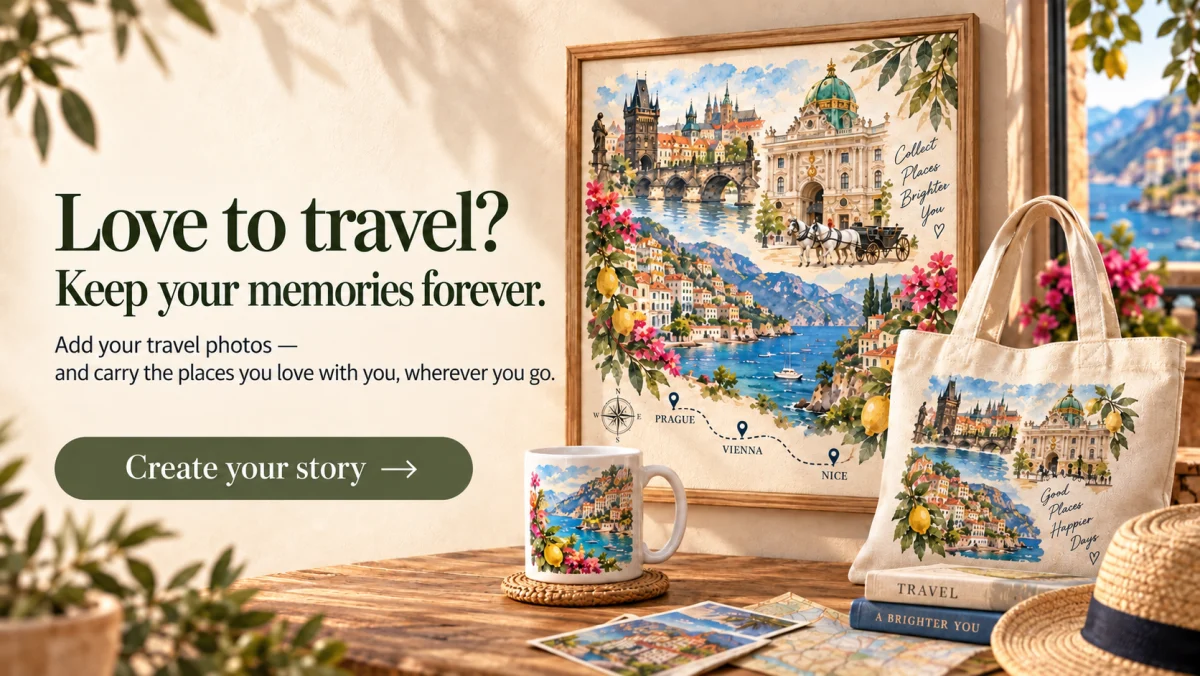
Travel Portrait: a guided generative image workflow
Travel Portrait starts with a customer-provided reference photo, places from a journey and a short memory. The customer can choose an artistic direction such as watercolor, a vintage travel poster or a storybook illustration. Our application turns those choices into a structured brief for an OpenAI image-editing model. The photo is a visual reference, not a request to draw an unrelated, generic traveller.
Instead of sending the same instruction three times, the system requests three distinct compositions: an intimate portrait, a wider scenic image and an editorial travel collage. The brief also carries constraints: preserve recognizable features and the correct number of people or pets, use only appropriate motifs from the stated destinations, and avoid invented personal facts, logos and unwanted text. The customer sees the alternatives and chooses the one that feels right.
This is the product layer around the model. A durable generation job, input validation, fixed output settings and customer selection make the experience more predictable than a single open-ended prompt. Exact route labels and typography are handled separately by the application rather than entrusted to the image model. That gives us better control over names, places and the final print layout.
Explore Travel Portrait and create your artwork → The artwork-creation pilot is available now. Physical orders will open after print verification; the product page shows the current ordering status.
What kind of AI is this, and does it train on each photo?
The generative component is a pre-trained multimodal image model used for reference-based editing. In general, a neural network learns during a separate training process that adjusts its weights. A production image request is inference: it uses those learned weights with new input. The model behind our workflow has been trained by its provider before our application calls it; the provider controls the underlying training process. PortrayMe does not train a foundation model from scratch, and an individual order does not fine-tune its weights or create a new personal neural network.
The adaptation happens at generation time. Reference images, the route, the memory, subject type, chosen visual style, composition rules and preservation constraints all condition one request. Change those inputs and the generated result changes, even though the underlying model weights do not. We then use the customer's choice to select the artwork for that order; choosing a version is not, by itself, a training update.
True model training would be a separate process: a rights-cleared dataset, a training run that changes model or adapter parameters, an evaluation set and a controlled release. Our PFD AI Research architecture note discusses approaches such as LoRA and evaluation for future creative systems. It is a research roadmap, not a claim that Travel Portrait currently uses a custom-trained LoRA. The live product's advantage today is the controlled workflow built around image editing, not a claim of proprietary foundation-model weights.
Year in Memories: your photos, your story, your calendar
Year in Memories Calendar takes a different approach. You add one of your own photos for each month, then add a place, a caption and an optional special day. The editor shows the pages while you work and builds a 26-page PDF—a cover, twelve photo pages, twelve month grids and a final page—on your device.
We deliberately do not describe this step as AI image generation: the calendar keeps the photos you selected. Its intelligence is in the product workflow—turning a year of memories into a consistent layout, checking that all twelve months are complete, and preparing a file suitable for download or printing.
The PDF preview and download are available online. For a physical A4 wall calendar, the current checkout offers delivery in Germany and France. Payment is confirmed through Stripe, and the finished print file is passed to Gelato for printing and fulfilment after the customer places an eligible order. Availability and delivery options should always be checked on the calendar product page.
One collection, two honest promises
Travel Portrait is for the moment you want a photograph and a route transformed into new personal art. Year in Memories is for the moments you want to preserve as they were photographed, month by month. In both cases, a digital experience leads toward a meaningful object rather than a generic souvenir.
Our broader work at PFD Studio explores practical AI tools for creators and businesses. PortrayMe applies the same product-thinking principle to personal memories: use the model only where generation adds value, keep exact data and production steps under application control, and let a person choose what is worth keeping.
- Create a Travel Portrait — reference-guided AI artwork with three compositions.
- Make a Year in Memories Calendar — twelve personal photos, PDF preview and eligible print delivery.
- Explore PortrayMe — the home for personal art and keepsakes.
